Glossary
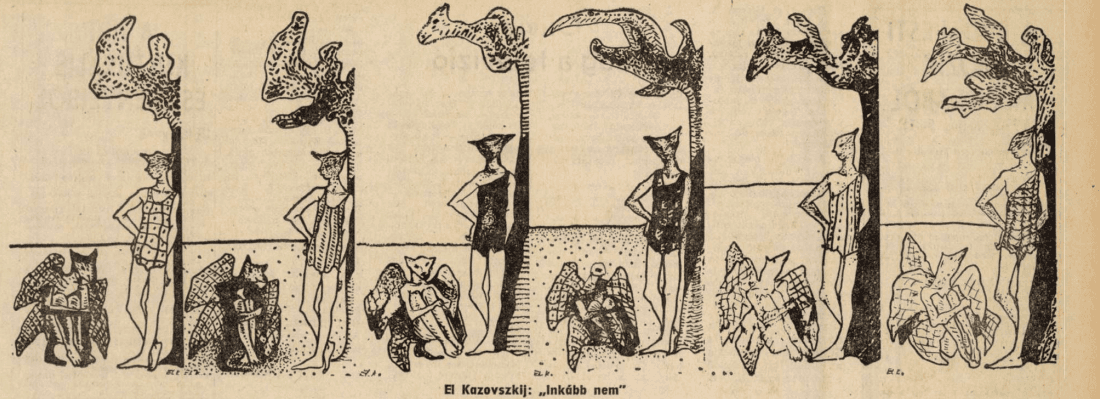
El Kazovszkij / El Kazovszkij
The Cyrillic spelling of Казовский transliterates to Kazovsky in English and Kazovszkij in Hungarian. I followed the later transliteration to emphasize the artist’s Hungarian cultural embeddedness and treat the chosen name as the signifier of the Artistic Self performed in the Hungarian cultural field.
he/him
Although the Hungarian language has no grammatical gender, El Kazovszkij stated that in every other gendered European language, he uses male pronouns. This revelation unravels the historical, theoretical and linguistic concerns that may arise from the choice of pronouns.
they/them
As the Hungarian language has no grammatical gender, in the quotations translated from Hungarian to English, I use the singular they/them for the third person in generic sentences, where the third person’s gender is not implied in the vocabulary.
queer / homosexual-lesbian / LGBT+
I am using the word queer as an inclusive umbrella term for all the diverse SOGIESC (sexual orientation, gender identity, gender expression and sex characteristics) as well as for forms of social or artistic behavior that oppose cis- and hetero-normative binary concepts of gender and sexuality distinctively from politico-cultural identity rooted in the 1980’s American socio-cultural context. The term indicates description and not interpretation.
I depart from this terminology in two cases. The first is when discussing legal categories between adult people under state socialism. I narrow the queer terminology to a more precise description of homosexuality and lesbianism, which, translated to the relevant legal categories, refers to men who have sex with men and women who have sex with women. Or else when specific individuals are mentioned who have identified themselves as homosexuals or lesbians.
LGBT+ terminology appears when it comes to specific identity politics units, whether in the United States of America or its emergence in post-socialist regions due to globalization.
East Central Europe (ECE) / Eastern Bloc / Second World / Eastern Europe
The terminology referring to the non-fixed, historically changing geopolitical or metageographical region of Eastern Europe varies depending on the context. The most common term I used is East Central Europe, ECE. Following Piotr Piotrowski’s deliberations In the Shadow of Yalta, Art and the Avant-garde in Eastern Europe, 1945–1989, by East Central Europe, I refer to those former Eastern Bloc countries and their successor countries that remained under the Soviet sphere of influence following the 1945 Yalta Conference decision. Including Czechoslovakia, Yugoslavia, East Germany, Poland, Romania, Hungary and Bulgaria. Piotrowski’s definition of this geopolitical entity refers to the cultural and political history and their temporal geopolitical situatedness during the Cold War and its aftereffects. Furthermore, in terms of the intersection of my research between art and queer history, these are also those Eastern Bloc countries where, with the exception of Romania, homosexuality was not criminalized during the Cold War (Poland) or where legislation decriminalized consensual homosexual practices between adults during this period (Czechoslovakia, 1961; Hungary 1961; East Germany, 1968; Bulgaria, 1968; and in certain parts in Yugoslavia (Croatia, Slovenia, Montenegro and the Socialist Autonomous Province of Vojvodina, 1977)).
By the Eastern or Socialist Bloc, I refer to the group of socialist states under the influence of the Soviet Union that existed during the Cold War. Additionally, although the use of Cold War triple world division terminology is controversial and seen as outdated, I occasionally use the term Second World as a synonym for the Eastern Bloc when discussing the then and now legacy of Cold War epistemic dichotomous hierarchies.
State-socialist vs. communist
The term "communism", which is also predominantly used by the international academic community to describe the political systems of the Cold War-era Eastern Bloc, has long been a subject of debate. Some political and social historians reason that the East Central European states never had an established communist political system. It is argued that they were socialist or state-socialist countries by virtue of their political, ideological and social arrangements. Therefore, in my dissertation, I use the term state socialism to describe the political system of the ECE countries under Soviet influence.