Fellowship at the Open Society Archives, 2025 Budapest
We have no censorship - György Aczél
There is censorship in Hungary. - Ferenc Kőszeg
We are dependent on the temperament of the censor - Karl Marx
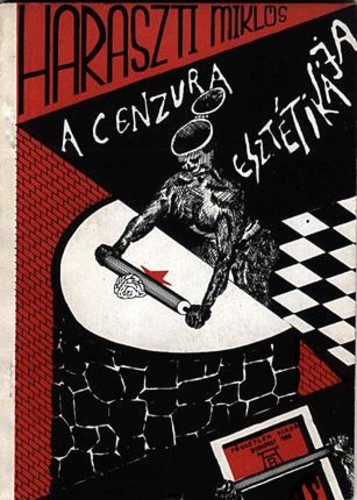
Censorship is no longer a one-off, external intervention... A new culture has emerged in which art and censorship mutually reinforce each other. ... State control has moved into art because the artist has moved into the state. - Miklós Haraszti
In the Republic of Hungary, everyone has the right to freedom of expression and speech and the knowledge and dissemination of information of public interest. - Act XX of 1949
within and outwith censorship
To support my upcoming projects, I propose two maybe surprisingly interrelated topics - (1) state socialist queer representation and (2) the figure of György Aczél - centered around the contemporary understanding of state-socialist censorship through a particular lens of Miklós Haraszti and his seminal work, The Aesthetics of Censorship/ The Velvet Prison. Artists Under State Socialism. In revisiting certain aspects of censorship’s mechanisms and effects, my inquiry combines theoretical approaches with pre-existing evidence-based, pragmatic reconstructive research combining elements of political, legal, social, and cultural realities.
As an art historian specializing in the state-socialist and early post-socialist periods, my research consistently intersects with the issue of censorship, often encountering the term as a catch-all phrase applied indiscriminately to various inconveniences faced by cultural actors. My discursive conformism lasted until my PhD when the vast contradictions encountered ejected me from the disciplinary paradigm. I have started to explore the differentiation between categories of, e.g., existing and being actively censored in the culture of censorship, non-dominant and marginalized themes, and the ray of possible intentions, relevance and quality of action by both the actors’ and the authorities’ side, etc. In this inquiry, encountering Haraszti’s work was a breakthrough in organizing my thoughts, a theoretical process I wish to develop further.
within
(1) in my dissertation, I critically re-examined the standard categorization of “queer censorship” within state-socialist regimes. Rather than subscribing to the broad and often unnuanced narrative belief bias, I focused specifically on how political, legal, and social histories intersected with the existence of queer artifacts. Besides debunking the epistemic formation of the belief, my research includes a dedicated chapter that challenges the presumption of thematic censorship, supported by a database I developed to enable both quantitative and qualitative analyses of queer cultural artifacts from this era. To discredit the belief, I have published a mixed method paper, Circulation of Queer Ideas in State Socialist Hungarian People’s Republic, and my latest paper Deconstructing Imagined Queer Censorship in the State-Socialist East Central European Cultural Fields: The Hungarian Case, currently under review, continues this line of inquiry.
I am working on a regional comparative study that extends this analysis across Hungarian, Polish, Czechoslovak, and East German self-constructed databases combined with the above-described interdisciplinary reconstructive aim. Now I wish to take a further step and, following Haraszti’s work, build a theoretical framework to map the borders of the queer episteme of the time through the situatedness of queer artifacts, i.e., public representation in the realm of the directed culture. This project not only enriches the theoretical framework underpinning my earlier work but also brings transnational and transdisciplinary perspectives into the discourse on state-socialist censorship through a queer lens.
Additionally, I plan to utilize further archival materials from the OSA, particularly documents relating to the experiences of sexual minorities under state socialism. I am also keen to look into the files of Károly Makk and Erzsébet Galgóczi, whose film Another Way is one of my favorite case studies.
outwith (?)
(2) while I was already challenging the dominant censorship narratives, in 2023, I was targeted by politically motivated censorship by the current Hungarian opposition (link 1., 2.) Conversations with fellow censored peers about the profound psychological impact of even seemingly minor acts of suppression have deepened my understanding of the trauma censorship can inflict, which might be best described with an existentialist understanding of Lukácsian disillusionment. This experience has also reshaped my perspective on national, regional and global censorship narratives and remembrance: the ethical issues of blurring together essentially different scenarios that are only similar on a surface level.
While censorship is typically examined through the lens of systematic operations or biographical elements, I would like to explore the possibility of juxtaposing it with another perspective through the psychology of censorship, which examines it through philosophical and ontological categories. This approach interrogates how the right to opinion, expression, and denial relate to an individual’s sense of existence and recognition. It considers the strategies of cooperation and resistance individuals use within the frameworks of written and unwritten rules, where those in power can interpret and override these rules on a case-by-case basis.
In this approach, I also find Haraszti’s theory a good starting point, particularly challenging or further enhancing his Heroic Naiv category through the non/agency in the performed willingness of non/aligning with the system rules resulting in censorship. I would distinguish between the Heroic and the Naiv, based on the hypothetic experience of the Naiv: disillusionment and the disintegration of the self in itself due to expulsion of recognition.
As part of this process, on the OSA’s behalf, I plan to conduct interviews with Miklós Haraszti and Ferenc Kőszeg, where I will invite them to contribute as both theorists and subjects of censorship together to explore the possibility of talking about the psychological approach in differentiating between different kind of censorships.